Lake Farm Centre Menu
Blogs | Lake Farm Centre

Our Blogs

July 31, 2023

What is the difference between intellectually disabled (challenged) and mental illness?

A person who is intellectually challenged or disabled has limitations in their cognitive functioning and skills, including conceptual, social and practical skills, such as language, social and self-care skills. In other words, they struggle with learning, understanding, processing information and problem-solving.

Read the full blogRead less

Intellectual disability is usually present from birth and is evident before adulthood. A parent realises very early that the baby or child is not reaching developmental percentiles as they should. Intellectual disability is a permanent condition, not an illness or disease, and is not treatable. It may present itself as a specific syndrome that includes intellectual disability.

With adequate support, people with intellectual disabilities can learn life and other skills, such as handcraft, depending on their ability. This way, they can become involved in their community and make meaningful contributions. A person with an intellectual disability will need lifelong support and care and cannot live or work independently.

Lake Farm Centre is such a community – where people with intellectual disabilities reside in a community where they are given support and taught skills; they participate in communal living and socialise in an environment where they are accepted and valued.

Any person, irrespective of their intellectual ability, can have a mental illness. Mental illness affects mood (emotions), perceptions (thinking), and behaviour. It usually manifests itself during adulthood; it is unlikely that the illness will present itself before a child reaches puberty. With treatment, the symptoms of a mental illness can be well managed, and the person can live a normal independent life. Persons with intellectual disabilities can have a mental illness. As with anyone with a mental illness, these symptoms are treated with the appropriate medication.

July 31, 2023

Welcome to our Sustainable Income Project – “Lake Farm Agri” Farming Project!

At Lake Farm Centre, we believe in embracing uniqueness and finding beauty in our differences. Our farming project is not just about producing vegetables; it symbolises our commitment to becoming self-sustainable and securing a bright future for our residents.

Read the full blogRead less

We designed our vegetable and herb farming venture to generate much-needed income for the Centre, ensuring that we can fulfil our mission and vision for years to come. With a focus on commercial food production, we are planting vegetables on the farm and in greenhouses to provide high-quality produce.

You can now find our fresh and delicious herbs & veggies in local shops!

Non-profit organisations like ours in South Africa face the challenge of finding sustainable income solutions to support our long-term goals. Our “Lake Farm Agri” project is our response to this challenge, aimed at ensuring the future sustainability of the Centre.

With the expertise of a seasoned farmer who understands our vision, we are determined to grow this project to its full potential. However, we can’t do it alone. We need funding and sponsors to help us nurture this initiative and create a thriving and self-sustaining income source. Join us in celebrating the beauty of our differences and supporting our Sustainable Income Project. By doing so, you’re not just contributing to the success of a farming project; you’re making a profound impact on the lives of intellectually challenged adults in our community. Together, we can cultivate a brighter future, food security and embrace the beauty of being different and beautiful.

March 15, 2024

What Is An 18A Certificate?

Section 18A of the Income Tax Act (Act 58 of 1962), as amended by the Revenue Laws Amendment Act (Act 45 of 2003) entitles a taxpayer (an individual or a legal entity, including a trust) to deduct annual donations to certain public benefit organisations (PBOs). This amount must not exceed 5% (five percent) of their taxable income.

Read the full blogRead less

A donation is given voluntary and freely by the donor out of generosity to a donee (the person receiving the donation) without expecting anything in exchange.

Who May Issue A Section 18A Certificate?

Not all NPO’s and PBO’s qualify to issue an 18A certificate.

Donations to an eligible PBO for the issuing of section 18A receipts are restricted to specific organisations approved by the Commissioner and is granted to PBO’s listed in PART II under public benefit activities (PBA’s).

In other words, not all PBO’s can issue an 18A certificate.

Qualifying PBO’s are recognised by Government as organisations dependent on the generosity of the public. To encourage this generosity, a tax deduction for certain donations is granted to taxpayers.

Lake Farm Centre is an approved Section 18A PBO, because the services we provide falls within the public benefit activities categorised in PART II.

What Kind Of Donations Qualify?

Donations can be in the form of cash (money) or of property in kind.

South African cash

Cash does not include, for example, school fees, raffle payment, memorabilia and other assets donated to be auctioned to raise funds or the value of free rent, water and electricity provided, or amounts paid to attend a fundraising event, membership fees, prizes and sponsorships donated for an event, etc.

Property in kind includes, for example, computers, vehicles, office equipment, shares or trading stock, property purchased, manufactured, erected, installed, or constructed by or on behalf of the taxpayer for example carpets or cupboards installed or security fencing and buildings built.

Technology equipment

The donation of a service such as time, skill or effort to a section 18A-approved organisation will not qualify as a deduction for purposes of section 18A, since a service is not a donation of property made in kind.

What Information Does A Qualifying Donor Have To Provide?

A section 18A certificate issued to a charitable donor requires the display of specific information. Additional information is required from March 2023. Below is a list of this information.

  • Donor nature of person (natural person, company, trust etc.)
  • Donor identification type and country of issue in case of a natural person.
  • Identification or registration number of the donor in case of a business, etc.
  • Income tax reference number of the donor.
  • Contact number of the donor.
  • Electronic mail address of the donor.
  • A unique receipt number.
  • Trading name of the donor if different from the registered name.

For more information download the Basic Guide to 18A approval by clicking on the button below.

Basic Guide to 18A Approval

April 30, 2024

NISBOERE EN LAKE FARM CENTRE

Lake Farm Centre featured on a Nisboere (Niche Farmers) KykNet Program on the 31st of March 2024, Nisboere 8 Episode 10.

Watch the videoClose

An extract from the Nisboere Facebook article of 1 April 2024…

“Lake Farm is allermins aan hul eie lot oorgelaat. “Ons neem plaaslike mense in diens – veral vroue uit die omliggende gemeenskap. Wat die bestuur van die landbouprojek betref, verkry ons die deskundigheid van mense uit dié bedryf. Ons verpak self, versprei self, doen ons eie bemarking. Dis ’n ten volle geïntegreerde kommersiële proses. Ons is besig om in die rigting van landbouproduksie op ’n baie groter skaal te beweeg.”

May 6, 2024

Provider or Testamentary Trusts

There is not a parent with a vulnerable child who does not worry about what will happen to the child after they die. Securing a financial future for a dependent with special needs is of utmost importance. Once you as parent passes away, how well will the day-to-day needs of your dependent be met?

Read the full blogRead less

Dependents who have special needs often require caregiving or specialised equipment or medical assistance or they may need to be accommodated in a facility for special needs individuals, which requires financial provision for the duration of their lifetime.

A life insurance policy ceded to the dependent is a good plan, but how does one ensure that these funds are managed in a way that the parent can be sure it takes care of the needs of their dependent for their lifetime?

An unfortunate reality is that a nominated guardian might mismanage or squander the funds intended for the person who has special needs, leaving them with little or nothing to survive on.

According to South African law, an inheritance cannot be paid to minor children. This means that, in the absence of a provider or testamentary trust or any other specific testamentary provision, assets left to minor children will be sold, and either placed in the Guardian’s Fund, which falls under the administration of the Master of the High Court, or in an account in the name of the child’s legal guardian. The funds in the Guardian’s Fund are not easily accessible, and the process can frustrate a guardian who is trying to release funds for a beneficiary’s benefit.
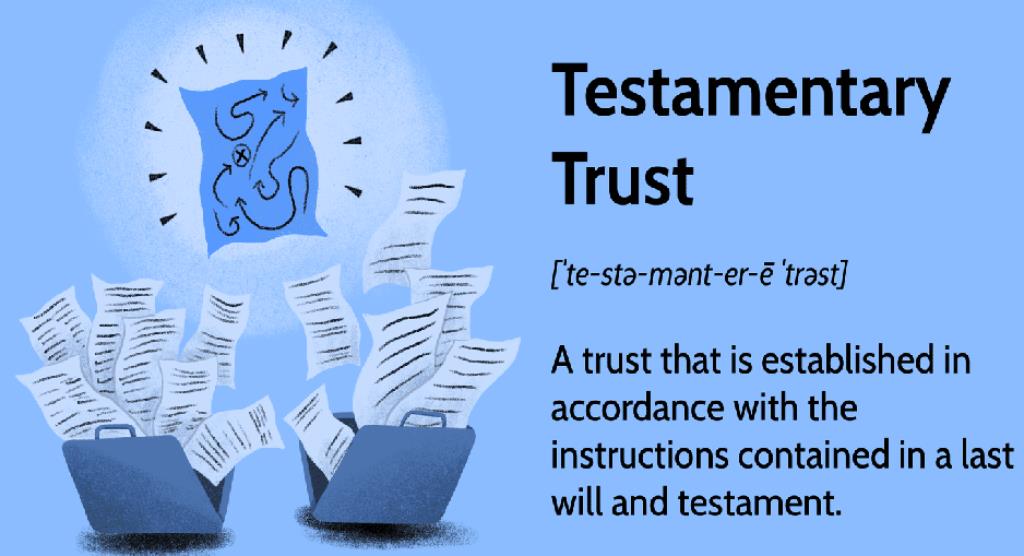
What is a testamentary trust

The Provider / Testamentary Trust

One way to prevent these problems from occurring is to create a provider trust (also known as a testamentary trust) through a last will and testament. With a Testamentary Trust, the terms are written into your will and only come into existence after your death. Your will therefore forms the basis of the trust document. You can direct how and when funds should be paid. Because this trust is only established on your death, it does not provide any protection for your assets during your lifetime.

What To Consider When Appointing A Trustee?

A trust has at least one trustee, though there is no limit to the number of trustees appointed. The trustee is the person who will decide how the inheritance set aside for your dependent/s will be managed, and how much money should be spent on their care and maintenance until, in the case of minor children, they reach a specific age.

The trustees do not need to be a professional accountant or such, but they should understand the Law of Trust and what a trustee should and should not do.

Although you can nominate the same person to be both trustee and guardian of your family member, this may cause a conflict of interest. It is advisable also to appoint an independent person as one of the trustees; someone committed to the interests of the beneficiaries of the trust.

What About Taxes?

Upon your death, your assets will still be liable for estate duty, because the testamentary trust only comes into existence after your death. At the time of death, your assets still belong to you and will therefore form part of your estate. This means estate duty (if applicable) will first be subtracted from your estate, before being transferred into the trust.

If a dependent with special needs suffers from any mental illness as defined in the Mental Health Act or any serious disability as defined under the Income Tax Act, the testamentary trust is treated leniently from a tax point of view. This means more of your money goes towards looking after your loved one. To qualify for these tax benefits the disability must make it impossible for the individual to earn money to support themselves or for them to be able to manage their own financial matters.

Your estate may be charged an initial trustee fee by an institution that manages trusts, for the setting up the trust, and an annual fee for trust maintenance may be charged.

The cost of not drawing up a proper will and testament and trust may amount to a lot more e.g. all assets turned into cash and being held in the Guardians Fund, managed by the government.

What Is The Difference Between A Trustee And A Guardian?

A guardian is appointed in your will to care for your dependent on a day-to-day basis, including providing a place to live and making sure they are cared for in all respects.

A trustee is appointed to manage the trust’s assets and make sure the beneficiaries’ benefit, such as using income the trust earns to pay boarding fees or medical- and other expenses.


September 11, 2024

Why you MUST have a last Will / Testament

Having a last will / testament is non-negotiable, especially if you have minor children or a vulnerable adult child.

Read the full blogRead less

If you choose not to draft a will or your will is found to be invalid, you will be deemed to have died intestate.

Without a Will, you forfeit all control over the division of your assets and what happens to your children, pets, and precious belongings; you are essentially allowing those appointed by the courts to handle your affairs. Sometimes the state’s decisions may go against what you wanted for your family and finances.

Many people have funeral policies and life insurance in place, but doesn’t deem a last Will as important. This is unfortunately not true. A valid Will is possibly the most critical component in securing your family’s financial future when you die.

The consequences to the family of someone dying intestate are never ideal and can lead to heartache for those left behind, particularly if there are children or a vulnerable adult child involved – their future can be seriously at risk.

What happens to Your Belongings & Money if you don’t have a Will?

If you die without a will, your money and belongings are divided according to the Intestate Succession Act, 1987 (Act 81 of 1987). This Act is very specific about how assets are divided i.e. they are divided among close relatives in order of relation.

For example:

  • If you are survived by a spouse but no children, your spouse will receive the entirety of your estate.
  • If you have a spouse and children and die intestate, your spouse will receive the same as a child’s share of the estate or R250,000 of your assets, whichever is more i.e. your children will receive an equal share of the balance of your estate after your spouse has received their portion of your money and belongings.
  • If you die without children or a spouse, your extended family i.e., your parents, siblings, aunts, and uncles will inherit from your estate according to how closely related they are.
  • If you don’t have parents, siblings, aunts or uncles to inherit your estate, your nearest relative will inherit your estate, and this could be someone you did not even know.

Who becomes the Executor of your Estate if you Die Intestate?

When someone dies with a Will, they indicate who their estate’s executor will be. This isn’t the case when you die intestate.

The executor is the person responsible for dividing the assets according to the wishes of the deceased and is usually someone the person trusts to handle their affairs. But, without a Will to indicate who this person will be, the responsibility of who the executor is falls to the Master of the High Court.

Although the heirs to the estate can nominate an executor to the Master, this may not be the person the Master appoints, especially if the heirs are not in accord. This is often where the delay in the dividing of assets happen, which can then take years.

What if There are Minor Children or a Vulnerable Adult Child?

Possibly more important than the division of the assets is what happens to minor children or a vulnerable adult child when someone dies without a Will.

This can be a devastating experience for children, especially in the case of a single parent dying, as they are ultimately either placed with a legal guardian appointed by the state or in foster care.

If only one parent passes, the other parent typically becomes the legal guardian of the children. However, if the other parent is not active in the children’s lives or can’t be located, the state will determine who the legal guardian should be according to the state’s assessment of what is in the child’s best interests.

Read the blog on Provider / Testamentary Trusts for more info on how to secure your vulnerable adult child’s future.

Please click the link below to read more about what the experts say about The Unintended implications of dying intestate.

Read the Moneyweb article

March 5, 2026

FARMING FOR THE FUTURE

After sixty-six years, this Centre is feeling the financial pressure to continue to provide a home for the intellectually challenged adults that calls it home.

Read the full blogRead less

Fundraising takes place in a constrained economic environment with an ever-increasing demand for financial aid. In a nutshell, humanitarian needs are outpacing available humanitarian aid. To address the aforesaid constraints, we have embarked on a commercialisation programme, introducing Lake Farm Centre’s Agriculture Project.

How can you Help?

  1. Speak to us,
  2. spread the word,
  3. support our Back-a-Buddy Campaign by committing to a monthly donation, or
  4. commit to a project specific donation.

Please click on the button below to learn more about our farming venture and our wish list.

Farming Venture & Wish List

Please click on the button below to donate today!

Donate Today

More from Lake Farm Centre

Watch our videos on YouTube
Lake Farm Centre Footer